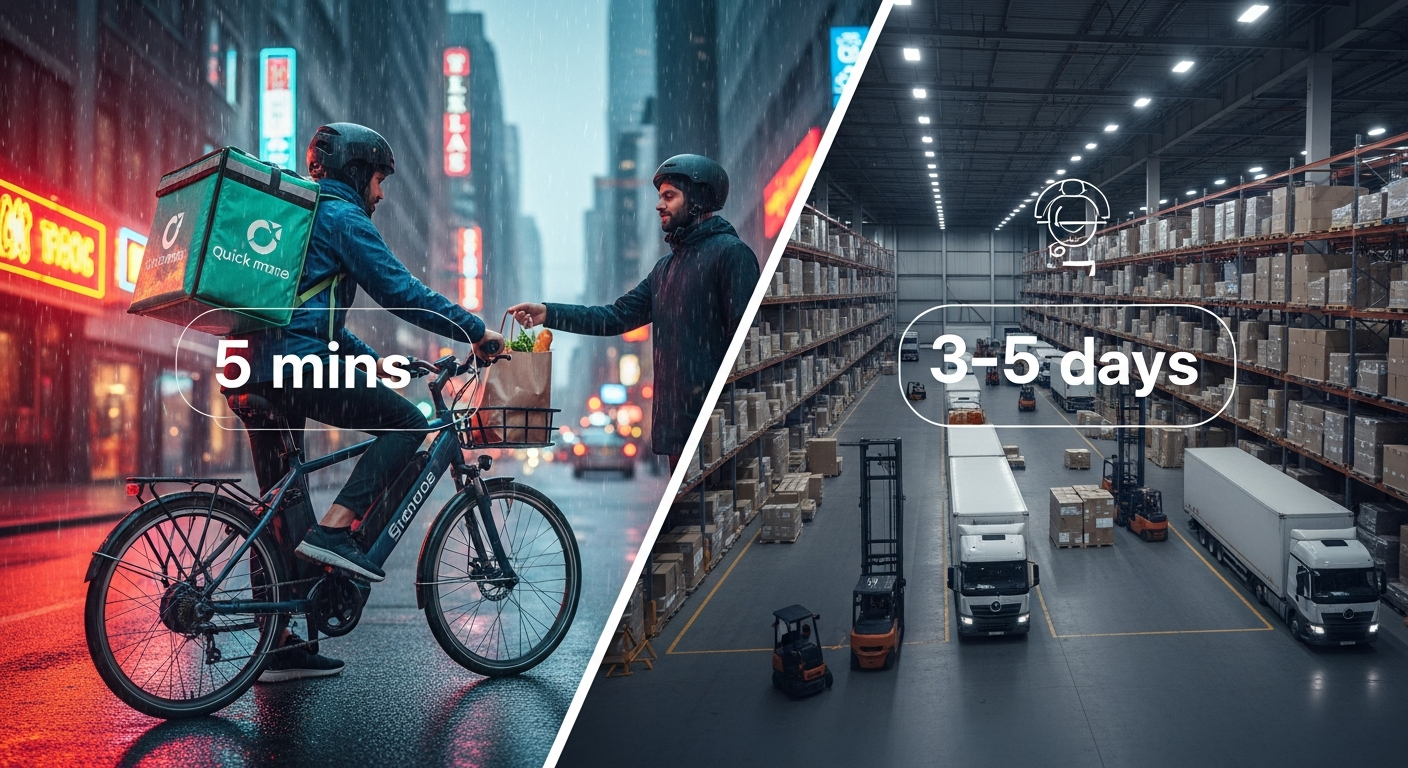
The manner in which individuals make purchases through the internet has changed at a very high rate and in 2026, velocity will have become the largest competitive edge. Customers no longer wish to wait days to have products delivered when they can have their products delivered in minutes. This has necessitated the creation of Quick Commerce (Q-Commerce), a paradigm that is changing the nature of business operations, and how customers make decisions to purchase a product. Although traditional eCommerce remains the most widespread in terms of scale and variety, Q-commerce is redefined as expectations are shaped with instant delivery and hyperlocal fulfillment.
What is Traditional eCommerce?
Traditional eCommerce can be defined as the normal model of online shopping where people view the products in the online store, order and have the products delivered within a few days. This system is constructed to be efficient, scale and cost efficient.
Major Characteristics of Traditional eCommerce.
- Large product assortment in a variety of categories.
- The delivery times are usually 1-5 days.
- Warehouses and fulfillment facilities which are centralized.
- Attractive prices with regular discounts.
- Appropriate when purchasing in large and bulk quantities.
Understanding the traditional eCommerce mode of operation.
The conventional eCommerce business model has been built on large-scale logistics networks. The storage of the products is centralized in warehouses and when a customer makes an order, it goes through various stages-processing, packaging, shipping and final-mile delivery. This model emphasizes on the reduction of cost and an increase of reach as opposed to speed.
The given structure makes it better suited to customers that plan their purchases ahead of time and are more concerned about being able to afford their purchases than with being under time pressure. It also enables businesses to have good inventory management and also be able to provide a wider range of products.
What is Quick Commerce (Q-Commerce)?
Quick Commerce is a new type of retail that aims to provide the highest speed of delivery, usually 10-30 minutes. It emphasizes convenience and immediacy over the wide range of products.
The main characteristics of Quick Commerce.
- Extremely rapid delivery of up to 10-30 minutes.
- Decreased stock based on the needs.
- Dark stores or micro- warehouses.
- The Hyperlocal logistics systems, and delivery services.
- Created to be an emergency and impulse buy.
The way Quick Commerce is conducted.
Rapid trade is based on a chain of small warehouses, which are located near the customers. These dark stores have high demand products and are designed to be fast picked and packed. After one places an order, it is processed and delivered to a delivery partner that takes a few minutes to deliver the order.
The efficiency is guaranteed by the use of advanced technologies such as AI-based demand forecasting and optimization of the routes. This model works well particularly in cities whereby the population density enables quick delivery activities.
Some of the main differences between Quick Commerce and Traditional eCommerce.
Delivery Speed
Quick commerce has been able to deliver the products within a few minutes as compared to traditional eCommerce which usually takes a few days. This disparity will have a great influence on customer anticipation and purchasing patterns.
Product Range
Traditional platforms provide a large number of products in their catalog, and Q-commerce has focused on a limited number of products that they often purchase as a necessity.
Logistics Model
In contrast to the traditional eCommerce where warehouses are centralized and thus located in a single place, Q-commerce employs decentralized and hyperlocal fulfillment centers.
Pricing Strategy
Conventional eCommerce focuses on discounts and affordability. Conversely, Q-commerce can set a little more costly price in order to provide a quicker service.
Customer Intent
Traditional eCommerce is suited to planned purchases and Q-commerce is designed to address the needs of urgent and impulse buying.
The reason behind the increasing popularity of 10-Minute Delivery.
Changing Consumer Behavior
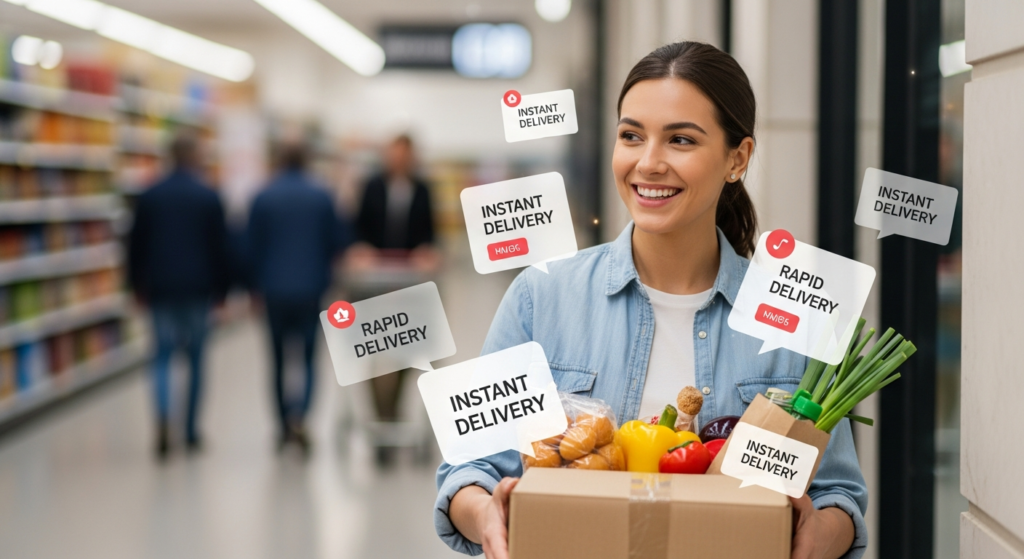
Today consumers demand an immediate response. The possibility to have goods within a few minutes is ideal in the dynamic lifestyles and convenience of digital devices.
Urban Convenience
In the metropolitan cities, individuals usually require things in an emergency. Fast trade saves time and effort as one does not have to go out to do it.
Technology Integration
Such innovations as AI, real-time tracking, and smart systems to work with inventory have enabled the possibility of rapid delivery and made it effective.
Increased Competition
The speed of delivering services is being contested by businesses and the whole of the industry is taking steps towards faster fulfillment models.
Development of On-Demand Culture.
On-demand services, like food delivery and ride-hailing, have conditioned consumers to expect speed in all the aspects of their lives.
Quick Commerce challenges.
High Operational Costs
Having several dark stores and a huge number of people working on deliveries adds a lot of expenses to the functioning of the organization.
Limited Inventory
Space is limited and due to space constraints, Q-commerce platforms are only able to stock a limited range of products.
Profitability Issues
Striking the right balance between delivering fast and sustainable margins is one of the key concerns of companies.
Environmental Concerns
The number of small deliveries made frequently can result in higher carbon emissions when not carried out in an environmentally friendly manner.
Scalability Limitations
The expansion of Q-commerce to small towns and rural communities is not an easy task as compared to conventional eCommerce.
Online shopping in the future.
Online shopping is in a hybrid form where the merits of both traditional eCommerce and quick commerce are combined. Companies are already testing the idea of integrating the delivery options that are faster than those currently integrated with their systems.
With the ongoing development of technology, we can predict the appearance of such innovations like drone deliveries, autonomous vehicles and smarter logistics networks. These innovations will make further delivery time easy and efficient.
Finally, the greatest beneficiaries will be the customers since they will be able to make a choice between speed and saving based on their needs.
Conclusion
Quick commerce is transforming online shopping with the emphasis on speed, convenience, whereas traditional online commerce remains to provide a variety of options and affordability. To achieve the success of online retail, a balance between these two models needs to be established. In this changing environment, businesses that align with the current consumer demands will be in a better position to address the new demands of the consumers and remain competitive in the digital marketplace.
FAQs
1. What is quick commerce?
Quick commerce is an online shopping model, which delivers goods within minutes using the warehouses and fast logistics of the area.
2. What is the difference between it and traditional eCommerce?
The primary distinction is the speed of delivery, product line and the logistics organization.
3. Does quick commerce exist everywhere?
It is presently primarily located in urban regions because of the need to have infrastructure in place.
4. What causes quick commerce products to be very costly at times?
Due to the increased speed of delivery and the increased costs of operation the prices may be a little higher.