
AI shopping agents are starting to alter customer shopping experiences on ecommerce sites. With AI, consumers can easily turn these tasks over to the machines, saving them from manually looking for a specific product, comparing prices, reading reviews, and completing all checkout steps. These agents are capable of knowing what people like, being able to assess the products, compare sellers and even be able to make a purchase for people.
This change may also help to revamp ecommerce fraud detection. The traditional fraud systems will primarily analyze the behavior of the user, accounts, payment information, devices and transaction pattern. AI shopping agents bring in a new digital entity to the sales and shopping process. Ecommerce platforms might thus have to decide whether or not the customer is legit, plus whether the AI agent is permitted to act for the customer.
Fraud Signals Could Change When Agents Start Shopping
One way of detecting fraudulent transactions is to compare their activity with what is deemed normal customer activity, which is used in current fraud detection systems. Some of the traditional warning signals might not hold up as much if AI shopping agents are able to mimic real-life shoppers, as the two types of shopping agent may be quite similar.
- Faster transaction activity
- Unusual browsing patterns
- Higher request frequency
- Automated checkout behaviour
- The new agent ID signals.
Authorization Might Turn into a More Effective Trust Signal
Acknowledging an AI agent does not necessarily mean that all the actions an AI agent takes is legit. Ecommerce sites might also require to know exactly what the customer has actually provided the agent permission to carry out.
A customer may, for instance, give an agent access to the system to see what products at a lower price are available for purchase, and for the agent to proceed with the purchase if it is under $200. The platform may even need to get the customer’s approval for the same agent to try a $1000 business. The ability to give or deny permission might be a valuable attribute, as well as payment details and payment history, to indicate fraud.
Agent Identity May Become a Part of a Transaction Verification Process
As AI enters the ecommerce space, it is crucial that future AI-enabled ecommerce systems have ways to identify the AI agent that triggered a shopping action. Rather than applying to the customer’s account and payment, fraud engines might consider the relationship between the shopper and the program that they were using to make the payments.
The identity of a customer, an agent, the status of his/her authorization, payment method, amount of transaction, information about the merchant, and product category could be considered together in an ecommerce platform to evaluate customer identity. It would be more powerful to connect these signals which would form a larger trust chain for automated purchases.
Customer Intent May Be a New Fraud Detection Indicator.
Instructions given to AI shopping agents can offer ecommerce fraud systems with valuable data pertaining to what the customer actually intended to get.
As an agent, you are asked by your customer to search for shoe products that are under $150, with trusted retailers and have running shoes. The risk score may increase if the transaction suddenly starts to buy expensive electronics from a new merchant that customers may not be familiar with, resulting in a mismatch of what they are buying and what their transaction is going for.
This is a new question that needs to be answered when it comes to fraud detection. Rather than examining the transaction at check-out, systems might be able to match up the final transaction with the instructions set that started the shopping process.
Behaviour Models Could Become More Contextual
They can create identifiable transaction patterns from the typical consumer interactions with the AI agent.They can learn transaction patterns that the consumer is used to interacting with the AI agent. Fraud systems can gain knowledge of the merchants, product classes, amount of spending and nature of transactions that are typically linked to a certain customer-agent relationship.
If there is an abrupt change, this could cause further verification. With this method, ecommerce companies would be able to not only assess the context of the activity that is being automated but automatically dismiss it as a suspicious activity, as well.
Five Controls Could Protect Agent-Driven Ecommerce
The ecommerce fraud prevention battle may extend beyond the one security call to make at checkout, as the autonomous shopping experience continues to gain in popularity. Platforms can be constantly assessing risk all along the shopping process.
- Verified agent authentication
- Customer permission validation
- Continuous behavioural analysis
- Purchase intent matching
- Risk-based customer verification
Trust Scores May Vary for Each Deal
AI agents could have the ability to get some fixed classification as trusted or untrusted. They may be able to have different levels of trust in the various situations of each purchase.
An agent who has been known to order a common household item from a retailer he/she is familiar with might be quite low risk. A purchaser who tried to buy a property abroad from a different vendor, might find himself having a significantly higher risk score.
A dynamic trust scoring system may be a way to ensure secure shopping but with still a level of convenience autonomous shopping will provide.
Ecommerce Security Could Become a Multi-Identity System.
The traditional concept of security in ecommerce is primarily on the customer, merchant, payment method and transaction. There are several more relationships which could be added between the AI agent, agent provider, ecommerce platform, and payment network: Agentic commerce.
Thus, fraud systems might have to comprehend how these identities are linked with each other. It will be more important to have secured agent credentials, customer authorization, behaviour history, transaction history and real-time risk analysis.
Fraud Detection might come earlier in the Shopping Journey
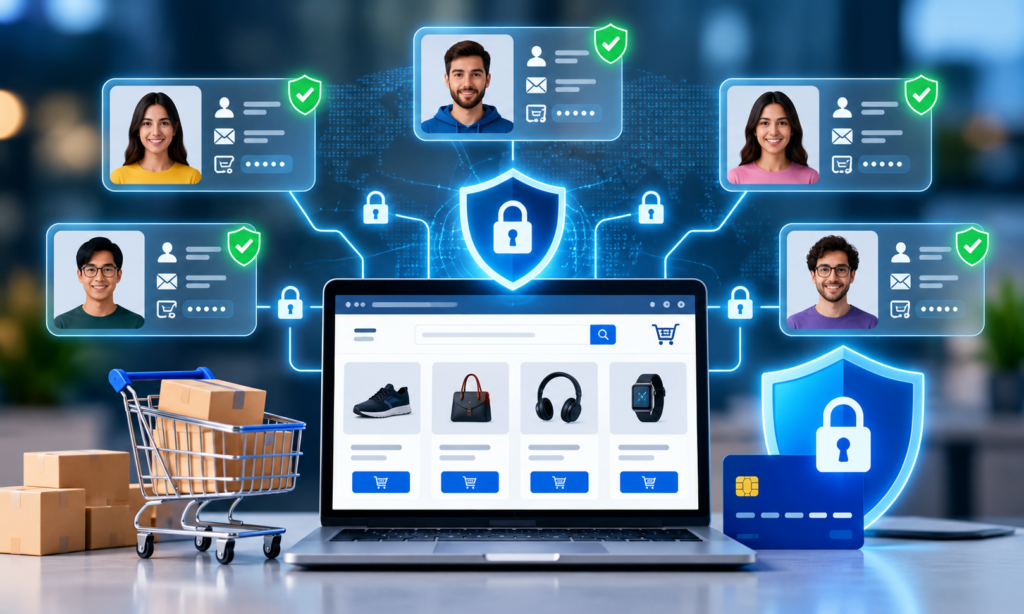
Preventing fraud is now most prominent when logging in, checking out and making payments. Product security risks may be brought up earlier in the shopping process, from discovering a product until preparing a transaction, by AI shopping agents.
Platforms could also provide authentication or limit sensitive actions before damage to financial assets are done if suspicious agent behaviour is detected prior to checkout. This might become a process of fraud detection, instead of a last step when making payments.
Conclusion
The future of ecommerce fraud detection might get substantially impacted by AI shopping agents, as deals may be conducted more and more via software working directly for the customer. Whilst these factors (payment history, account activity, device information, transaction value etc) are still going to be significant, there will be a need for more context.
Permutations of customer identity and agent identity, permission, purchasing intent, behaviour and real-time transaction information might be used in future fraud systems. This more comprehensive method may enable merchants to identify unauthorized automation actions, but also empower AI shopping bots for merchants to work smoothly.
Frequently Asked Questions
1. What is an AI shopping agent?
AI shopping agent refers to computer software that can go through the process of searching, comparing, choosing and possibly buying products based on a customer’s instructions and preferences.
2. Do AI shopping agents introduce new risks of fraud?
Yes. There can be new security risks if agents are impersonated, credentials are stolen, instructions are falsified, purchases are unauthorized, and automated fraud attempts are made.
3. How can ecommerce platforms verify shopping agents?
Authentication of agent identities, customer permissions, behavioural patterns, and transaction level security checks could all be integrated on platforms to help determine the authenticity of the agent.
4. Could shopping agents help detect fraud?
Yes. Customer instructions, quantity of purchases, preferred merchants and typical buying patterns may be other clues that can help identify suspicious activity.