Each online purchase makes an assurance that the correct product will arrive safe and sound, within the predicted time frame. It’s not a label on a shipping box that needs to be printed to keep this promise. Ecommerce order fulfillment
integrates the components of inventory, warehousing, delivery partners and communication with customers into a single streamlined process. All these activities will help prevent errors and preserve margins. Below are examples of the processes and aids used.
Understanding Online Fulfillment
Ecommerce order fulfillment encompasses the workflow necessary to prepare and ship ecommerce orders, such as accepting goods, storing products, processing orders, shipping parcels and returns. Post-delivery is the final stage of the buying process and is crucial to its success. Accurate inventory levels, clear accountability and reliable system and human-to-human transfers are key to order fulfillment ecommerce operations.
Ecommerce Order Fulfillment Process: From Stock to Delivery
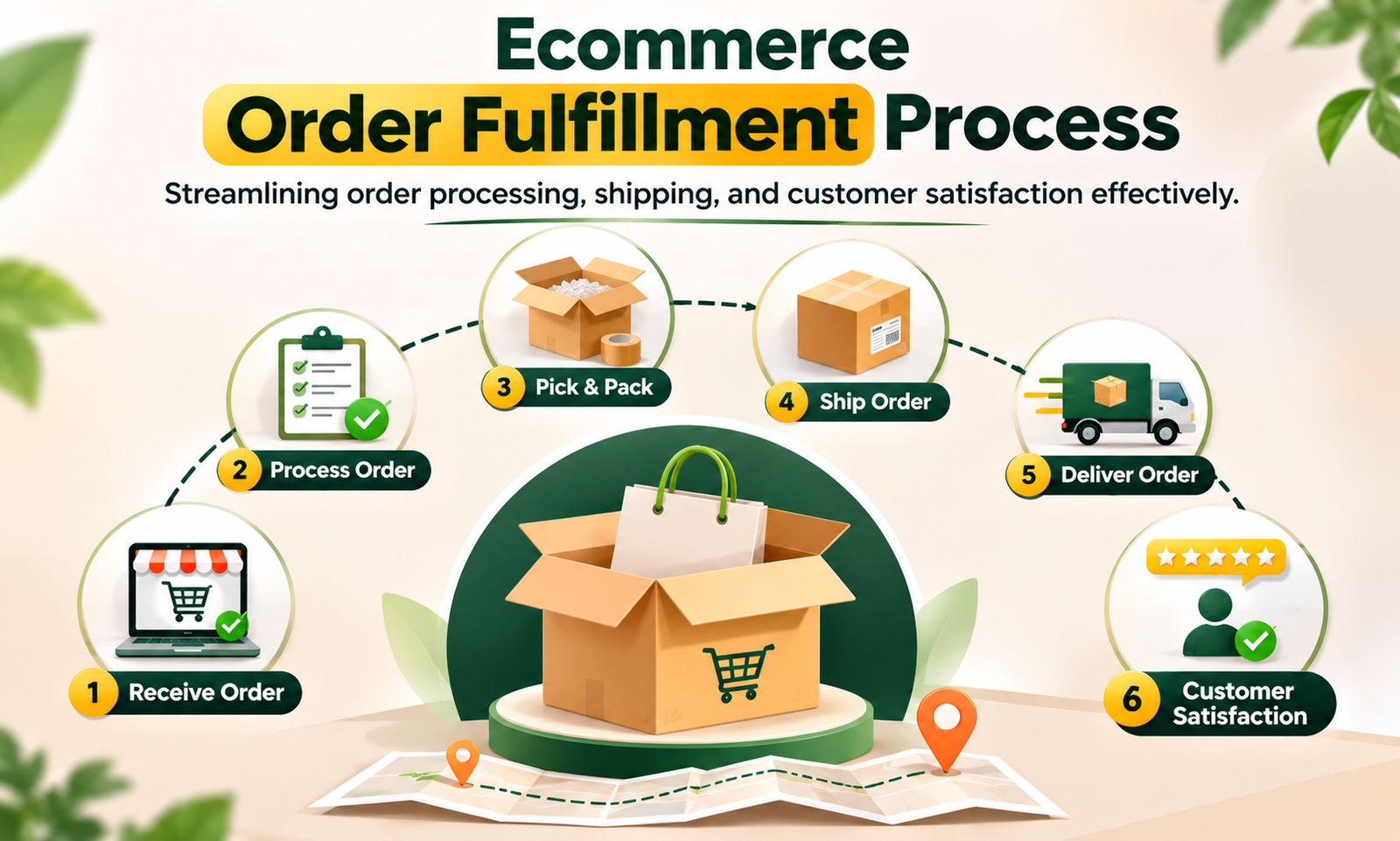
There are several steps in the ecommerce order fulfillment process that businesses can merge and/or automate.
1. Receiving and Organizing Inventory
Suppliers ship products to a warehouse, store or fulfillment center. Staff check received goods and compare with purchase orders, examine goods for damage and log accepted goods. Then there are recognisable spaces for the items to be stored. If they are received accurately there will be no discrepancies and cancellations. The consistent product identification and organized shelves provide the basis for reliable picking for order fulfillment ecommerce operations.
2. Capturing and Validating Orders
After a customer checks out from the store, the customer’s items, payment information, shipping choice and destination information are noted in the order management system. Nearly instant edits and changes should be made to inventory at connected retail outlets. Exceptions are identified before they are dispatched by doing address validation and fraud screening. A well set up ecommerce order fulfillment system is able to differentiate the “in need of review” orders from those which are ready to be prepared.
3. Picking and Packing Products
Pick teams work in warehouses to fetch the products from the pick list/ handheld scanner. Barcode checks can be used to ensure the right variants and quantities. Packers consider the fragility, size and transport circumstances of materials to choose appropriate packages. The correct sized packaging can mean unused space and needless shipping costs are minimized. A final check prior to sealing in ecommerce order fulfillment can help reduce the chances of the wrong order or order that is incomplete.
4. Shipping and Tracking Deliveries
Labels are added to packed orders when the orders are received, and they are sent to carriers based on the order service levels, destinations and cost. Information to track should be updated with the storefront for customers to be able to track the progress. Make realistic estimates with your delivery. Escalation procedures for lost packages, missed scans and delays by the shipping companies are also a vital part of reliable shipping.
5. Returns and Exchanges Management.
Return will return workflow. Record Eligibility, Inspections, Refunds and exchanges. The products returned should be evaluated before they are returned, repaired or disposed. Efficient reverse logistics streamlines the process of getting the inventory back to the customer and at the same time keeps customers updated.
Best Practices for Ecommerce Order Fulfillment
Ensure that inventory is visible accurately.
Set up stock on websites, marketplaces and on-site for seamless restocking. Use the actual demand for each product rather than assumptions to set the reorder points with supplier lead times. Cycle counts can be used to detect discrepancies without having to shut down the warehouse all the time. Knowing what products are available, their locations in the warehouse and when they need to be reordered is essential to the success of e-commerce order fulfillment.
Design efficient warehouse workflows.
Place frequently bought items at packing stations, label shelves for easy access and have uniform practices for exceptions. With ‘batch picking’ for similar orders, this can also help to minimize walking; and with ‘zone picking’, larger facilities will benefit. Properly test the methods in real order patterns. In any order fulfillment ecommerce team, any effort that saves the team from unnecessary movement must not compromise on accuracy and safety of the employees.
Automate Repetitive Tasks Carefully
All your orders can be imported, inventory can be updated, labels can be printed and shipment notifications will be sent through one of the integrated software programs. Automation can come in handy especially if your fulfillment goes through several sales channels. Failing to record a record of integration failures, duplicate orders and unusual inventory changes should be monitored, however, for teams. Exceptions and error corrections still need to be done by the employees.
Minimize costs while maintaining service levels.
Separate out the packaging, storage, labor and carrier costs and returns. Look at the ways you can send things and consider not just postage, but the time they’re likely to take and how much it will cost. Follow up the costs of tracking and fulfilling orders, tracking complaints and delivery performance. Sustainable fulfillment must be both efficient and deliver a checkout experience on par with that promised.
Choosing an Ecommerce Order Fulfillment Model
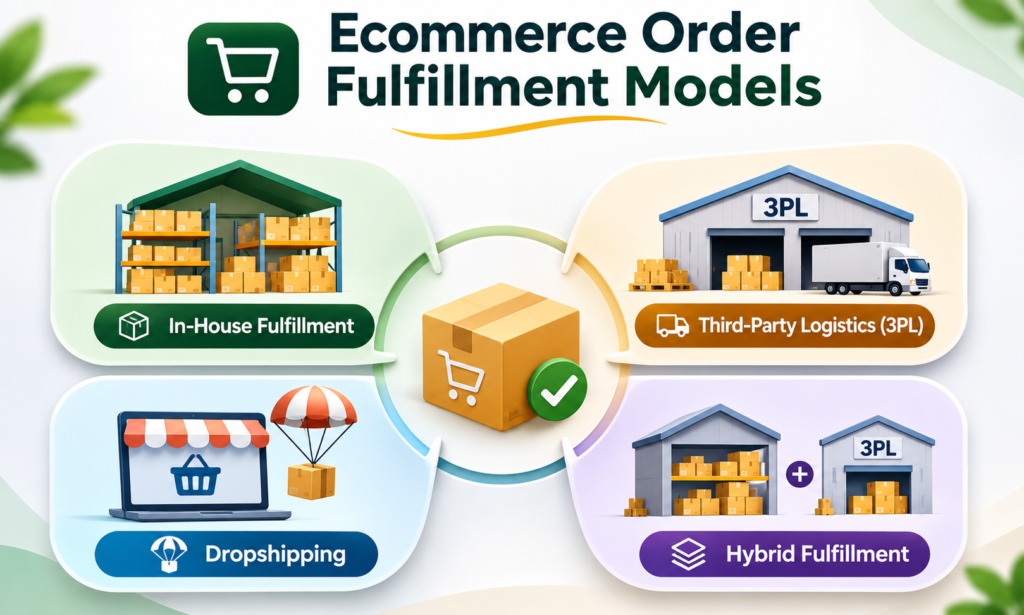
All of the above are considered in-house channels and are all classified as H3: In House, Third Party, and Dropshipping.
House fulfillment provides direct control of the packaging and quality, but needs staff, space and equipment. Third party logistics providers take care of the storage and dispatch for agreed prices, and are possibly able to help with expansion in other regions. Dropshipping assigns the responsibility of shipping to the supplier while decreasing inventory but at the same time, it decreases the control capabilities. Hybrid solutions are a combination of the different approaches for various products or destinations. Select an order fulfillment model for ecommerce based on the number of orders, product specifications, destination and pricing.
How to Measure Ecommerce Order Fulfillment Performance
Track order accuracy, time between order and dispatch, on time delivery, return reasons and cost of fulfillment for each order. Ensure that all the metrics have a consistent definition, so that comparisons are meaningful. Order accuracy indicates that there are no errors in the orders; on time delivery is a comparison of the arrival date of the order with the expected arrival date. Analyze trends on carrier and location. Teams can more easily identify recurring causes to efficiencies in the e-commerce order fulfillment process rather than taking individual complaints.
Conclusion: Creating dependable ecommerce order handling.
Fast delivery is only part of being successful with order fulfillment in ecommerce. It includes reliable inventory tracking, precise picking, packaging and protection, realistic commitments and quick returns. Start by identifying an area that is measurable, noting the current process and finding where the process is failing and costs money. Continue to review technology and fulfillment partnerships as demand increases, avoiding unwarranted complexity in the process to ensure quality.
FAQ: Frequently Asked Questions
1. What Is Ecommerce Order Fulfillment?
Ecommerce order fulfillment is the seamless process of dealing with orders, preparing products, delivering them, and returning them, if required, when they are ordered online. It relates warehouse execution to the expectations of the customers.
2. What is the time for an ecommerce order fulfillment process?
Processing time will depend on the availability of the stock, order cut-off, the capacity of the warehouse and shipping services. Send out and tell people when things are going to be dispatched and delivered at the same time, so they don’t mix up the two.
3. Can Small Businesses Manage Ecommerce Order Fulfillment Internally?
Yes. For smaller retailers, if orders are not that high, they can handle their orders on their own. Using a standard picking, inventory and carrier procedure aids with accuracy.
4. How Does Order Fulfillment Ecommerce Differ From Order Management?
Order Management manages all aspects of the purchasing process from the payment and routing, through changes and support. Fulfillment is related to the preparation and delivery of products.