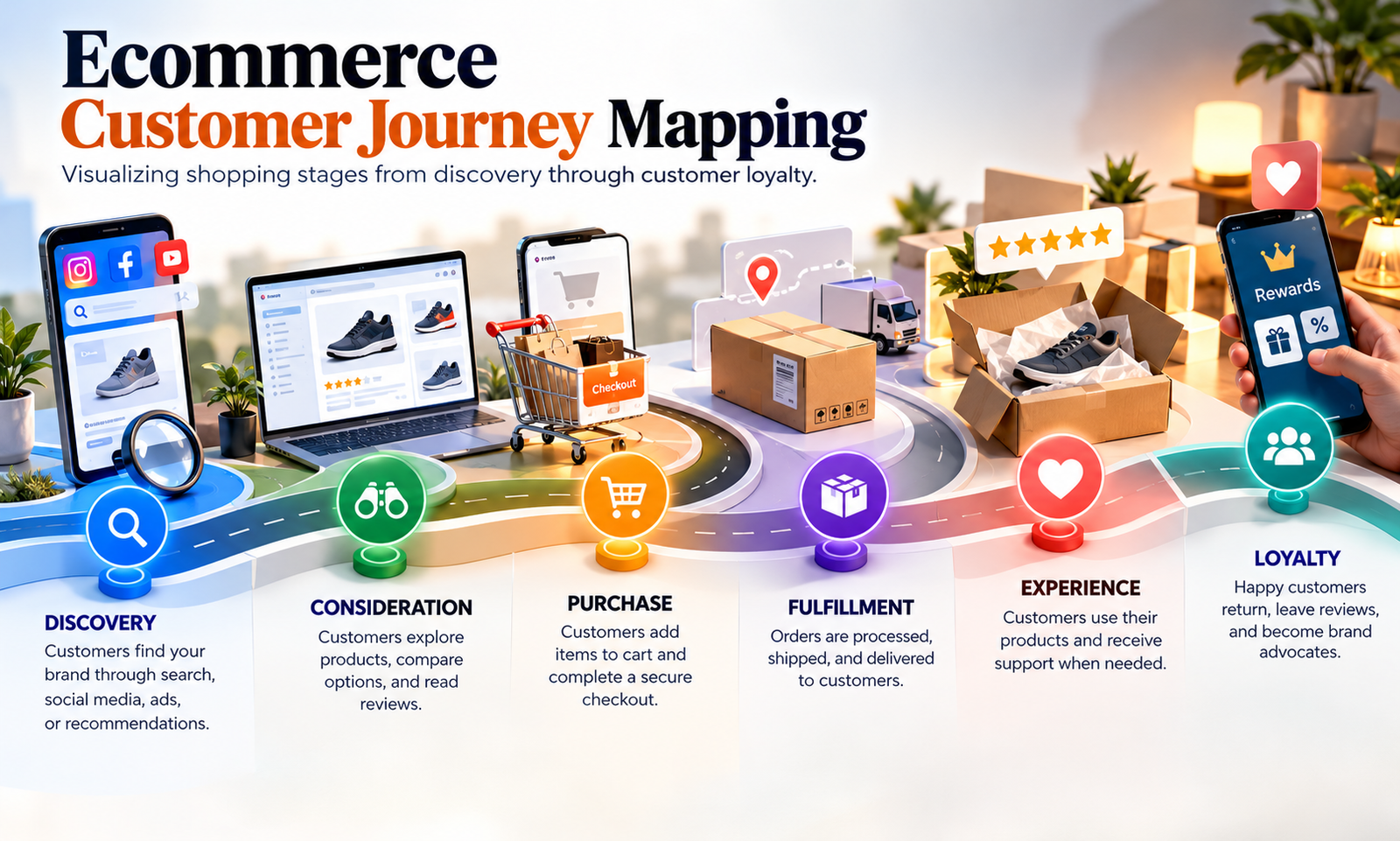
The ecommerce customer journey is seldom straight. A consumer could find a product on search, look at the other alternatives on social media and then leave without buying the product before finally returning via e-mail. Knowing about these movements, retailers can eliminate friction, and build a consistent experience. Revise their expectations that all visitors are prepared to purchase products or services, and consider the needs of customers during different stages of their interactions, and the impact each stage had on their decision.
Ecommerce Customer Journey Across Channels Understanding
The ecommerce customer journey consists of touchpoints that are undertaken before, during and after buying. These can include advertising, product page, product reviews, support discussion, delivery notification and returns. When plotted they show where expectations are fulfilled, where things get mixed up.
A practical ecommerce customer journey map demonstrates customer actions, questions, feelings and hurdles, with business actions. It should be based on a very actual funnel and not idealized. Analytics, interviews, support tickets and from abandoned purchases are all potential sources for teams to look to.
How to identify Intent in the Ecommerce Customer Journey
There are a variety of different motivations among shoppers at each stage of the buying process. There’s a need for someone who’s exploring a category to be guided and someone who’s comparing products to be provided with specifications. When it comes to your return, it may be important that your package is delivered on time. The teams should take into account the level of access they have, clarity of language and experience levels. This information is a factor in the people’s successful completion of tasks.
Trace Discovery and Product Evaluation
Discovery starts with a recognition of a need by the shopper, or a product, when it is relevant to their need. There are several ways that retailers can be introduced by search engines, recommendations, creator content, and referrals. Understanding the ecommerce customer journey is made simpler by understanding what channels do and don’t bring in browsers, and purchase ready visitors.
The customer can switch from the phone to the computer, from the computer to the friend and visit a retailer multiple times before making their decision. These are the breaks that occur between the different teams when analysing channels in isolation. Shared view creates a linkage between marketing promises and shopping experiences and service outcomes.
When evaluating, customers look at price, suitability, availability, shipping terms, and feel of the trust. Specific descriptions, realistic photos, compatibility information and easy policies are all provided by retailers. If you don’t know the answer to important questions, a detailed customer journey map of your ecommerce site can show you that these answers may be scattered all across your site.
Study Questions Prior to Customer Checkout
You can get a list of unanswered questions from search query, onsite and chat transcripts, and reviews. Often, asking consumers repeatedly about size will be better addressed by another guide than a banner. These qualitative signals describe actions that can only be captured with these metrics when analysing customer journeys for ecommerce.
Minimize the Slip During Cart and Checkout.
Placing an item into a shopping cart does not mean that the item will be purchased. Guaranteed shipping charges, necessary registration, restricted payment methods and open delivery timelines can derail the ecommerce customer journey. Complete review of checkout on mobile devices, test error messages and display the total costs prior to checkout confirmation.
Address entry, payment choice, and order review are all actions on a customer journey map that should be included in a practical ecommerce customer journey map. Teams can explore any awkward points in customers’ journeys and if there are any issues, they can find out on which device(s). Try out guest checkout, autofill and payment recovery. Store contents of cart when transactions are not successful; offer recovery instructions.
Ecommerce Customer Journey – Measure It With Meaningful Signals
Monitor product views, carts added, checkout process and payment failures along with feedback. Break down results by device, acquisition source and by customer type. These measures can be used to indicate where investigation is likely to be fruitful but can’t provide causes on their own.
Introduction to Connect Delivery, Support and Repeat Purchases.
After the customer has paid, the ecommerce customer journey doesn’t end. There are certain things that customers are looking for in confirmation, tracking updates, customer service and returns. When products are up to standard, but communications are not, it can negatively affect confidence.
Post purchase mapping should include questions about delivery, damaged products, and satisfaction and requests for a refund. Repeat purchases rely on experiences which researcher journey dashboards are unable to capture, which is why it’s valuable to do customer journey ecommerce research. Check on support themes along with the fullness performance.
Create Retention Strategies based on Customer Requirements
Appropriate reminders to replenish, setup information and timely support can help to induce return visits. Don’t send all the same promotional text messages to all. Respect consent and make communications controls easier, use purchase context/customer preferences. The ecommerce customer journey shouldn’t be overly promotional when they’ve made their purchase.
Create a Mapping Process Teams Can Maintain
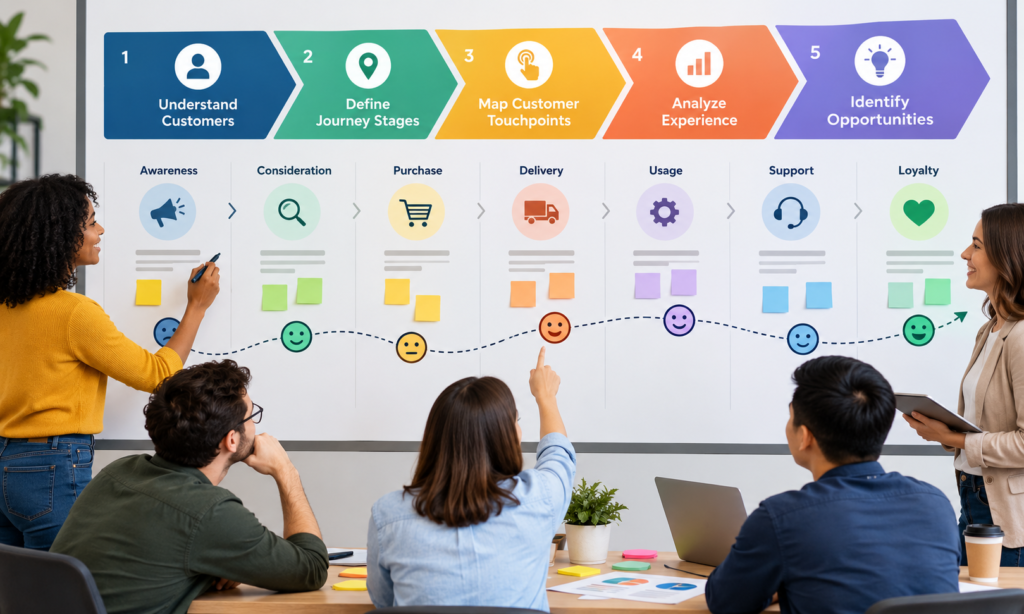
Begin with an audience segment, and a purpose or objective, like optimizing the first purchase completion rate. Record Entry points and decisions, Touch points and Barriers. Challenge and refute assumptions by using data and facts. A Customer journey ecommerce workshop is a great way to bring the marketing, merchandising, operations, and support teams together.
Create an ecommerce customer journey map containing all the journey stages, goals, actions, concerns, touchpoints, evidence and opportunities to improve. Delegate responsibility and set goals to which to aspire. Focus on the recurring issues, and how they affect customers, not just redesign everything at once. Note when the observations were made so as to differentiate between current and past beliefs.
It is most useful to have front line staff challenge the journey map. Have support staff identify recurring requests, inquire about delivery limitations with the fulfillment teams and compare to customer feedback. Regular, regular corrective feedback can increase accuracy with time and enhance the collaboration.
Test Improvements and Revisit the Ecommerce Customer Journey
Use one improvement strategy and record the anticipated outcome and compare the results with an appropriate baseline. Controlled experiments are useful to differentiate between the effects of seasonality, if possible. When there is a large-scale change in product, fulfillment or expectations of a customer, revisit the ecommerce customer journey.
Conclusion.
Mapping is critical and drives a strong link between the acquisition, purchasing, fulfillment and retention. It’s better for teams to identify obstacles, than to create pretty pictures. Journey mapping is very much a useful technique to help clarify, build trust and enhance the quality of services with evidence, ownership and regular review.
Frequently Asked Questions.
1. How does an ecommerce customer journey differ from a sales funnel?
A funnel represents the funneling towards conversion. When planning ecommerce journeys for your customers, a journey is used to look at the touchpoints, expectations, barriers and experiences before and after a customer buys.
2. What should an ecommerce customer journey map include?
Make sure to incorporate the customer’s objectives, phases, channels, steps, feelings, friction points, supporting data and chances for quantifiable enhancements.
3.What data sources can be used in ecommerce customer journey research?
Integrate analytics, search, interviews, support conversations, review and postpurchase feedback to gain insight into behaviour.
4.How often should teams update the ecommerce customer journey?
Revisit it when there are significant product, checkout, delivery, and/or consumer changes and periodically check assumptions.