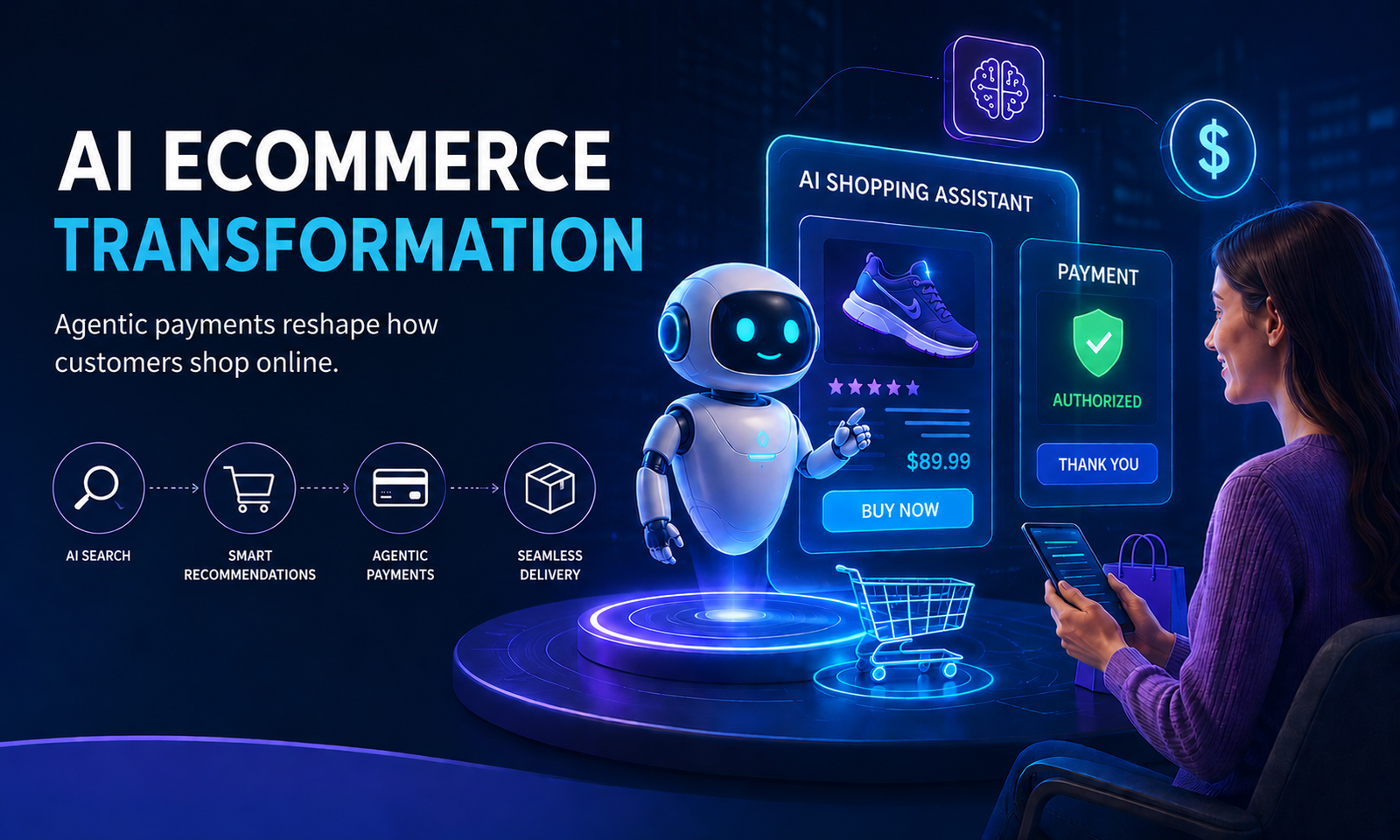
Artificial Intelligence is now becoming an integral part of ecommerce, enabling it to move beyond merely suggesting products and responding to customer queries and instead to taking more of an active role. As AI also gains the ability to be the shopper looking for products, comparing prices, and choosing appropriate options, it may even complete purchasing itself, making ‘-Agentic payments’ a new term that’s come into existence in recent times.
An online checker can increasingly be viewed as a purchasing assistant, versus customers having to manually handle all the parts of an online checkout. They are able to know what a customer likes, compare products available to them and make decisions according to a customer’s predetermined requirements. The change may usher in a new way for people to engage with online retailers and how companies will compete for sales.
Transforming Product Search into AI-Driven Checkout
Typical online shopping involves people shopping around, comparing products and adding items to their shopping carts, inputting payment information and confirming the purchase. What agentic commerce does is add a technology “in-between reality and the store.Agentic commerce is an automation point between the customer and the store.
AI Agents are the New Shopping Intermediaries.
Use of a natural language understanding interface for a shopping agent might make finding the best laptop that fits the price range easier, or reordering household goods when needed. The agent is not just showing the search results but can consider the options according to shoppers’ requirements.
This helps the buying process become more geared towards the goal. The customer specifies the desired end result, and all the work to be done of research and decision making is done by the AI.
Allow payments to become a part of the Agentic Workflow.
The payment stage is crucial since it makes AI more than just a medium of information; it uses it as a vehicle to action. An agent on their website could choose a payment type, double check the transaction details, and make a purchase, if they have authorization to.
Security measures continue to be in place. Automated transactions can be prevented from being made without authorization by setting the spending limits and permissions for merchants, confirming transactions, and authenticating them.
Ecommerce Decisions Get Data-Driven.
These factors encompassed product specifications, delivery times, price, availability, customer preferences, and past purchase history, among others, but it is likely that AI agents can consider several factors at once. This can help to speed up the shopping process, decreasing buyers’ labour.
Five Shifts Reshaping the Agentic Ecommerce Economy
- AI-powered product discovery: Agents are able to search, compare products based on shopper specific needs.
- Automated purchasing decisions: AI systems can make standard purchases automatically, based on designated instructions.
- New payment experiences: Electronic commerce checkout being ‘invisible’, with agents authenticated and dealing with payment in the background.
- Increased competition for merchants: Companies will need to refine their products and reputations for AI-powered buying tools, not just traditional search.
Building trust makes automated commerce a key element.
For an AI agent that has a budget, the convenience of using their device is not the only factor that becomes more significant. They must be assured that an agent listens to and understands clients’ commands and won’t offer them products they will not want.
This can be aided by transparent permissions. For instance, in the case of higher spending, users may get a limit on their spending amount, include certain “allowed” merchants, even certain “required” brands, and even require confirmation for those particular merchants.
How Merchants will need to Prepare for the Machine Buyers.
Traditionally businesses optimize their eCommerce experience for their human shoppers. Agentic commerce is another audience – software which assesses the products in place of humans.
Product descriptions, pricing accuracy, product information, product shipping details, return policies, and structured product information may, therefore, gain in significance. If the AI agent doesn’t have all the confidence in interpreting a product listing, the merchant may lose a potential transaction.
Payment Security will require a greater level of safeguards.
As transactions are automated, security is raised to a new level. Some of these can help prevent potential misuse, such as authentication, spending on tokens, transaction monitoring, fraud detection and permission-based spending.
Its aim isn’t just to speed up the payment process. To develop a system in which AI can function without any interferences, but within a set of boundaries set by the consumer itself.
Customer Relationships may become “less store-centric.”
As more and more consumers resort to using AI agents for comparing and buying products, interactions with specific online ecommerce stores could decrease. The agent might be the main point of contact for a patron who is making a purchase.
This may further drive up the significance of brand loyalty and products, pricing, reviews, and consistent service delivery by AI systems that might choose sellers based on the competition.
What Businesses Should Change Before AI is the Buyer.
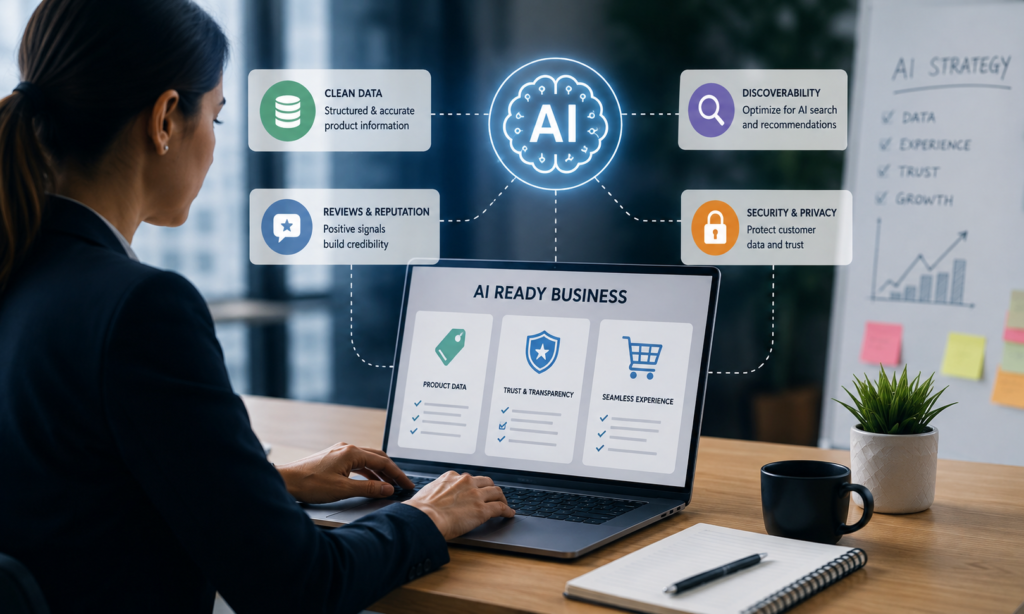
With the introduction of agentic payments, the eCommerce industry could be forced to think about the information it provides to its customers, as well as how it handles payments. In a future where AI agents play a growing role in purchase decisions, websites that focus solely on human navigation might fall short due to the rise of intelligent agents.Intelligent agents are becoming a more significant factor in the purchasing process, and websites geared entirely towards user interaction may not be enough to cater to customer needs in the future.
Seven qualities that a company should aim for are machine-readable product data, reliable cashier systems, secure payment authorizations, clear procedures, regular customer data, and catalog information, should be consistent. Additionally, they must think about their brand image inter comparison between a number of competing products by an AI system.
Conclusion
AI’s role in e-commerce is evolving beyond being a tool for consumers to be a player in the buying process, with agentic payments creating a new shape for e-commerce. Many product discovery, product comparison, product checkout and payment processes could be progressively going through an “intelligent agent” within user specified permissions.
It is a major opportunity: the ability to speed up the shopping process, make more individualized decisions, automate reordering processes and simplify payments. Meanwhile, secure, transparent, authorized and trusted product information will be crucial to consumer trust in these systems. The way people currently experience ecommerce could involve intelligent agents engaged in missions to shop for them, instead of them shopping themselves.
FAQs
What do you mean by agentic payments?
Agentic payments: Payments that are created and processed by AI agents, on behalf of a customer or enterprise. With proper instructions and authorization for purchase, these systems can potentially be used to make purchases.
How is agentic commerce different from traditional e-commerce?
Typical e-commerce typically involves searching, comparison and checkout functions on the shoppers’ end. Today AI systems can do more of these activities using the agentic commerce way, where the permission from the user, instruction, and preferences determine the activities that the AI system actually carries out.
Can AI agents buy things if they are not authorized?
Users and/or organizations must define authorization and spending rules for AI agents to enforce. To reduce the risk of fraudulent transactions, the strong authentication, spending limits, merchant restrictions, and transaction confirmations can be implemented.
What impact will agentic payments have on e-commerce businesses?
Businesses may need to make product information more machine-readable and ensure pricing, inventory, delivery, payment, and return information is accurate. Competition might start to happen with the product comparisons and recommendations made with AI.