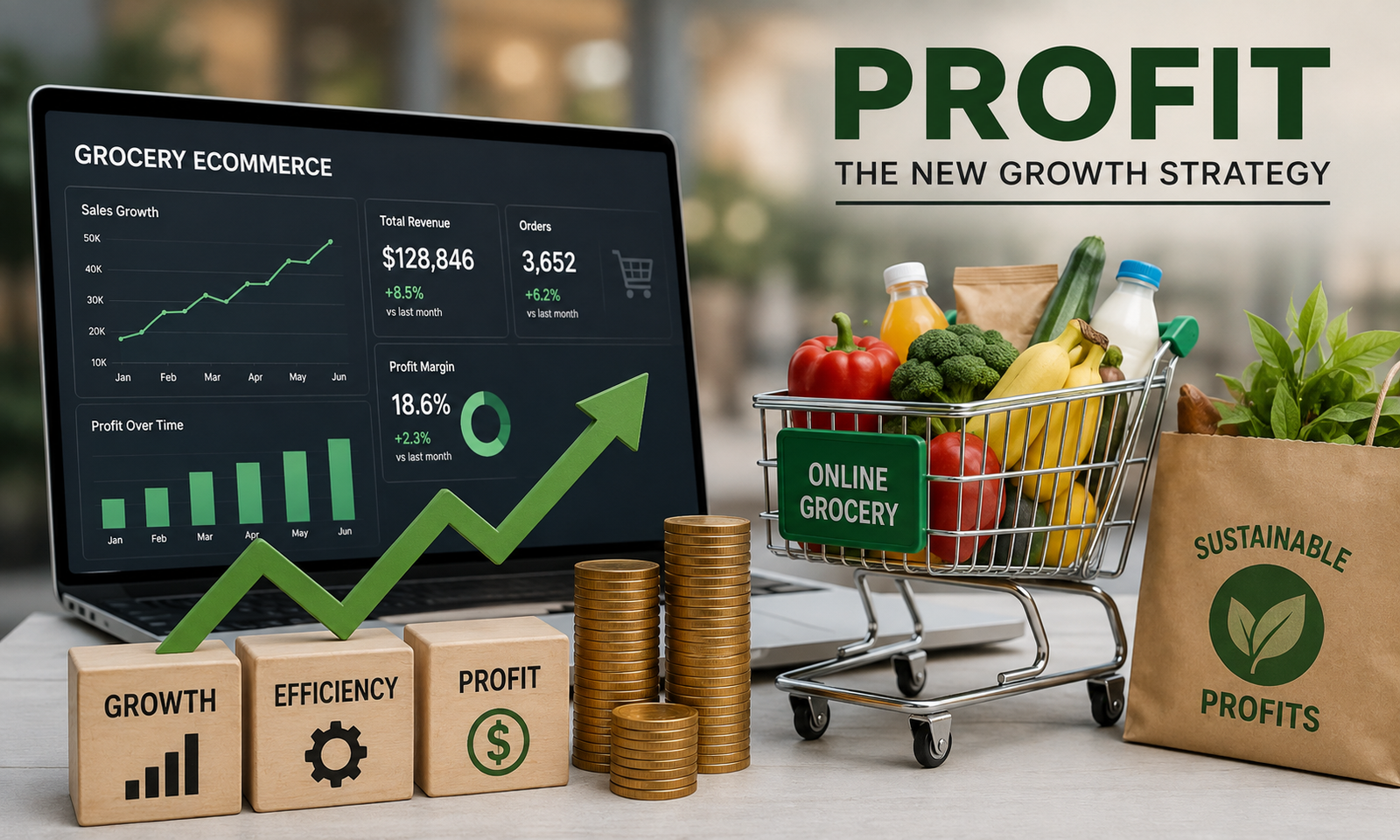
During the years, grocery eCommerce has been based on one key objective – growth at any cost. Reducing prices, giving away deliveries, attracting customers, the introduction of dark stores, delivery networks and a lot of expansion were all part of the strategy the retailers took to gain market share. Often, it would be more important to the revenue and order volume than whether or not any particular transactions were profitable.
It’s a strategy that will be changing in 2026. But, the grocery ecommerce companies are gradually turning their perspectives on how many orders they are able to generate to how much sustainable profit they can make from each order. As the costs of fulfillment increase and the last mile delivery is becoming a costly business, consumer behavior is evolving and investors are pushing companies to show a higher return, it has become almost impossible to sustain endless growth.
The economics of grocery ecommerce’s turnaround.
Grocery ecommerce is simply plagued by a number of issues: Firstly, the margins of food products are fairly low, and secondly, the fulfillment of an online grocery transaction comes with a number of extra expenses. All these various tasks—such as picking products, maintaining warehouses, packaging orders, speedy delivery, product substitutions, and refunds—can quickly eat into the profit margin created by a basket.
Retailers are thus becoming more discerning in who they choose to do business with, which orders to process and how they’ll expect orders to be delivered to them.
Basket Size is Gaining Importance over Order Count
When a big volume of smaller orders results in the impression of amazing growth figures, but poor economics, what have you got?When there’s a lot of smaller orders and it looks like you’re having great growth, but you don’t have great economics, what do you have? Supermarkets are incentivizing consumers to add more items to the cart since the more orders they can fulfill and deliver to, the more items will be in the cart.
If they were to rely solely on discounts to make consumers switch up their purchase habits, this wouldn’t be enough. Minimum order requirements, packaged promotions, subscription offers and personalized recommendations can help consumers raise the level of their shopping basket.
This changes the fundamental ecommerce metric from simply measuring orders to understanding contribution profit per order.
Delivery speed reconsidered.
Fast food delivery (and extremely fast food delivery) was an important competitive advantage but there is a price to speed. Having fulfilment networks with high density and providing small baskets in very short timeframes could impact on the profitability for a company.
Many grocery stores are now considering whether all orders are truly urgent so they can understand and prepare for the possibility that they may not have to sell it that quickly. Reducing delivery time, having scheduled deliveries, pick up services and optimized delivery routes can optimize the economics, without compromising convenience for the consumer.
Private Labels Taking a More Strategic Role.
Finding control over pricing and margins can be more easily provided for retailers through private label products than some branded products. With an increasingly profit-driven grocery ecommerce, it will become more profitable for retailers to offer their brands when customers are turning to them.
Private labels are easier to merchandise using the digital storefront, too, as it allows you to customize the recommendations, search placements, bundles, and category placements.
This Is The More Selective World of Promotions
Grocery platforms that have heavily discounted their products to gain customers quickly can be successful, but if they are continually offering a discount, then they can start training their customers to only buy when there is a discount. That makes the escalating volume of customers a challenging scenario in which they don’t generate enough economic value.
In contrast, retailers are more and more leveraging on the customer’s buying pattern, basket composition, customer lifetime value, margins of products, etc., to attract customers with specific offers.
Digital technologies are shifting from growth enabler to profit driver.
A change has taken place in the investment value of technology as well. AI, forecasting tools, inventory management, personalization tools, automation and more are now commonly used to boost the measurable business economics.
The issue with technology isn’t just one of orders but whether it can generate more orders. Retailers are increasingly interested in finding out if it could help to cut down on their waste, improve inventory turn, boost basket size, cut down on labour needs or be more efficient in their deliveries.
Five Profit Levers Reshaping Online Grocery.
Grocery ecommerce isn’t giving up on growth as the movement towards profitability continues. Rather, companies are attempting to discover development that yields more sturdy financials.
- More valuable baskets: Recommendations, bundles, subscriptions and cross-selling are ways that retailers are looking to boost revenue per transaction.
- Smarter fulfillment: Automation and better warehouse processes can cut down picking and packing and boost operational efficiency.
- Improved inventory forecasting: Accurate demand forecasting can minimize food waste, stockouts, excess inventory and markdowns.
- Optimized delivery: Route optimization and delivery windows can help to optimize single deliveries and keep the expenses low.
- Customer lifetime value: Retailers are not targeting all customers but those who come back and make recurring profits.
AI is Transforming Grocery Profitability from Within.
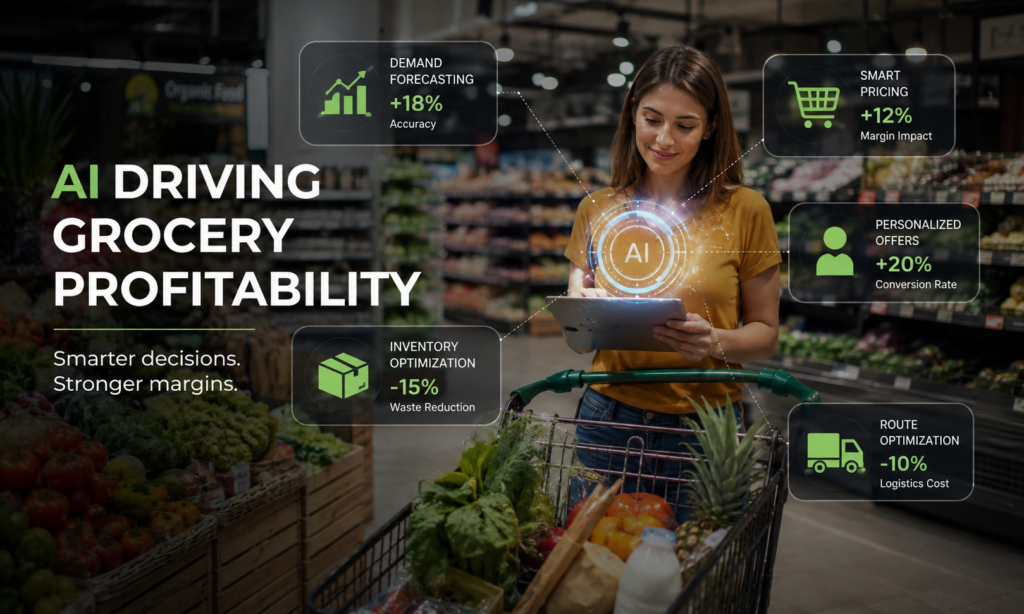
Artificial Intelligence can be extremely beneficial in the grocery sector as demand has a lot of fluctuation. Demand may change based on the weather, vacations, events and promotions in the local area, seasonality and consumer habits.
AI-forecasting can assist retailers to decide what amount of stock to have in specific stores. With better predictions, sales could be made without missing and stock can be avoided.
AI can also customize the product suggestions and promotions. Retailers can now make the decision that instead of providing a discount to all consumers, the best discount to offer would be one that would enhance a “profitful basket.
Conclusion
The consumer ecommerce grocery sector is moving towards more mature times. No more is it just about the number of customers, orders or geographic expansion that measure the success of the industry. Profits, contribution margin, basket economics, inventory efficiency and customer lifetime value are significant performance metrics that are ever more relevant.
Those stores that can both deliver convenience and have a tight-fisted approach to business are going to be the most successful grocery ecommerce companies. AI-powered predictions, profitable personalization, private labels, retail media, bigger carts and the efficient fulfillment are all tools that can help retailers create online grocery business models that won’t rely on endless discounts or economically unsustainable delivery systems.
FAQs
1. Why is grocery ecommerce turning its attention towards more profit?
Fulfillment, labor, inventory and last mile delivery expenses are some of the expenses that grocery ecommerce businesses are burdened with. While growth is increasingly difficult to come by, retailers are increasingly focused on getting better margins, basket value, CLV and sustainable unit economics.
2. What can grocery retailers do to make ecommerce more profitable?
There are several ways retail stores can maximize profits, such as growing basket size, route optimization, better inventory forecasting, selling private label goods, cut down on the number of unnecessary discounts and automate to cut down on fulfillment costs.
3. Is quicker grocery delivery losing its significance?
Though fast delivery is still sought after, retailers’ economic assessment of the cost of this is growing. Convenience in the form of the scheduled delivery/pickup and flexible delivery window can help reduce the cost of extremely swift delivery.
4. How does AI help grocery ecommerce companies make more profit?
AI can make better the prediction and forecasting of demand, inventory management, product suggestions, pricing, and customized promotions. These are the capabilities that can help cut down on waste, ensure that your stock is never out of stock, boost the value of your baskets and optimise your operations.